BT-401 · Mathematics-III/Unsolved PYQ Paper
BT-401 Mathematics - III - Jun 2023 Question Paper
Under each question, How to answer lists the points an answer should cover, outlined by CampusPrep from the syllabus. Check the details against your textbook.
-
7 MarksaFind the real root of the equation $x^3-3x-5=0$ correct to four places of decimals by Newton Raphson method.
How to answer
- Define Newton-Raphson iteration $x_{n+1}=x_n-f/f'$
- Locate initial root interval for $f(x)=x^3-3x-5$
- Iterate to 4 decimal accuracy
- State final real root
-
7 MarksbEvaluate $$\Delta^6(ax-1)(bx^2-1)(cx^3-1); h=1$$
How to answer
- Expand product $(ax-1)(bx^2-1)(cx^3-1)$ as degree 6 polynomial
- Use $\Delta^n$ with $h=1$ annihilates degree < n
- Compute 6th finite difference = $6! \times$ leading coefficient
- Simplify to $720abc$
-
7 MarksaUsing Newton's divided difference formula, find $f(8)$ and $f(15)$ from the following table.
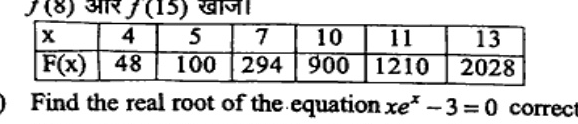
How to answer
- Construct divided-difference table for given x, F(x)
- Write Newton divided-difference interpolating polynomial
- Substitute $x=8$ to get $f(8)$
- Substitute $x=15$ to get $f(15)$
-
7 MarksbFind the real root of the equation $xe^x-3=0$ correct to three decimal places by Regula Falsi method.
How to answer
- Define $f(x)=xe^x-3$ and bracket root
- Write Regula-Falsi formula
- Iterate until stable to 3 decimals
- State root
-
7 MarksaUse Simpson's 1/3 and 3/8 rule to evaluate the following. $$\int_0^1 \frac{dx}{1+x^2}$$ Hence obtain the approximate value of $\pi$ in each case.
How to answer
- Take suitable n for 1/3 and 3/8 rules for $\int_0^1 dx/(1+x^2)$
- Apply Simpson 1/3 formula
- Apply Simpson 3/8 formula
- Use $\int_0^1 dx/(1+x^2)=\pi/4$ to get $\pi$
-
7 MarksbCompute the value of the following integral by trapezoidal Rule. $$\int_{0.2}^{1.4}(Sinx-\log_e x+e^x)dx$$
How to answer
- Identify integrand $\sin x - \log_e x + e^x$ limits 0.2 to 1.4
- Choose subintervals and compute ordinates
- Apply trapezoidal formula
- Compute final value
-
7 MarksaSolve the following system by Gauss Siedel iteration method. $$27x+6y-z=85$$ $$6x+15y+2z=72$$ $$x+y+54z=110$$
How to answer
- Check diagonal dominance and rewrite equations for iteration
- Write Gauss-Seidel iteration formulas
- Start with initial guess and iterate
- State converged x, y, z
-
7 MarksbUse Simpson's rule to find approximate value of the following integral. $$\int_1^2 \frac{dx}{x}$$
How to answer
- Identify $f(x)=1/x$, limits 1 to 2
- Divide interval into even number of strips
- Apply Simpson's rule formula
- Compute approximate value
-
7 MarksaUse Euler's method compute the solution of $\frac{dy}{dx}=y^2-x^2$ with $y(0)=1$ at $x=0.1$.
How to answer
- Identify $f(x,y)=y^2-x^2$, $x_0=0,y_0=1$
- Use Euler formula $y_1=y_0+h f(x_0,y_0)$
- Compute with $h=0.1$
- State y(0.1)
-
7 MarksbUse Euler's Modified method to solve the equation $\frac{dy}{dx}=x+y$, $y(0)=1$, $h=0.2$ compute $y(1)$
How to answer
- Write Euler modified predictor-corrector formulas
- Take $h=0.2$ from $x=0$ to $x=1$
- Iterate corrector to convergence at each step
- State $y(1)$
-
7 MarksaUse Laplace transform to solve the Initial Value Problem. $$y'+2y=26\sin 3t,\: y(0)=3$$
How to answer
- Take Laplace transform of $y'+2y=26\sin 3t$
- Use $y(0)=3$ to get $Y(s)$
- Take inverse Laplace via partial fractions
- State $y(t)$
-
7 MarksbEvaluate $$L(t \cos at)$$
How to answer
- Recall $L\{\cos at\}=s/(s^2+a^2)$
- Use multiplication by t property $L\{t f(t)\}=-d/ds F(s)$
- Differentiate and simplify
- State result
-
7 MarksaEvaluate $$L^{-1}\left[\frac{1}{(1+s)^3}\right]$$
How to answer
- Write $1/(1+s)^3$ in standard form
- Use shift / known $L^{-1}\{1/s^n\}$
- Apply first shifting theorem
- State $e^{-t}t^2/2$
-
7 MarksbEvaluate $$L\{t^2e^{-3t}\}$$
How to answer
- Recall $L\{t^n\}=n!/s^{n+1}$
- Use first shifting $L\{e^{at}f(t)\}=F(s-a)$
- Substitute $n=2, a=-3$
- State $2/(s+3)^3$
-
7 MarksaFind mean of Poisson distribution.
How to answer
- Write Poisson pmf $P(X=r)=e^{-\lambda}\lambda^r/r!$
- Define mean $E[X]=\sum r P(r)$
- Simplify series to $\lambda$
- State mean = variance = $\lambda$
-
7 MarksbWrite Short note on Exponential Distribution.
How to answer
- Define exponential pdf $f(x)=\lambda e^{-\lambda x}$
- Give mean, variance and memoryless property
- Mention applications in waiting time
- Conclude short note
Go to where you left off?
Quick Add to Notes
Save questions, your own notes and screenshots into notes filed by unit. It takes a free account.
Create free accountHave an account? Log in
Notes Panel