EC-502 · DIGITAL COMMUNICATION/Unsolved PYQ Paper
EC-502 Digital Communication - Nov 2023 Question Paper
Under each question, How to answer lists the points an answer should cover, outlined by CampusPrep from the syllabus. Check the details against your textbook.
-
7 MarksaDefine and explain sampling theorem for low pass signal. Also explain cross talk and aliasing effect.
How to answer
- Statement of sampling theorem for low-pass signal with Nyquist rate fs >= 2fm
- Explanation / proof using spectrum replication and reconstruction with LPF
- Definition of aliasing effect due to under-sampling and cross-talk
- Methods to avoid aliasing and cross-talk
-
7 MarksbExplain the generation and detection of PWM signal.
How to answer
- Principle of PWM - pulse width variation with message amplitude
- Block diagram of PWM generator using comparator / sawtooth
- Detection using low-pass filter / demodulator steps
- Waveforms for generation and detection
-
7 MarksaWhat is quantization and derive the expression of quantization noise?
How to answer
- Definition of quantization and quantizer types
- Quantization error model and step size
- Derivation of quantization noise power / SNR expression
- Effect of number of bits on noise
-
7 MarksbWhat is differential coding? What are its advantages and disadvantages?
How to answer
- Definition / principle of differential coding
- Encoding-decoding rule with example
- Advantages such as phase ambiguity resolution
- Disadvantages such as error propagation
-
7 MarksaHow to generate and detect ADM signal?
How to answer
- Principle of adaptive delta modulation (ADM)
- Block diagram of ADM transmitter with adaptive step
- Block diagram of ADM receiver / detection
- Advantage over delta modulation - slope overload and granular noise
-
7 MarksbWhat is inter symbol interference? How can it be minimized?
How to answer
- Definition of inter symbol interference and its cause
- Effect on eye diagram and BER
- Nyquist criterion for zero ISI
- Techniques to minimize - equalization, raised cosine filtering
-
14 MarksWith the help of block diagram explain the generation and detection of QPSK signal.
How to answer
- QPSK signal representation and constellation
- Block diagram of QPSK modulator / transmitter
- Block diagram of QPSK demodulator / coherent detection
- Waveforms / phasor explanation
-
14 MarksWith the help of block diagram explain the generation and detection of coherent and non coherent BFSK signal.
How to answer
- Principle of BFSK with two frequencies for binary 1/0
- Block diagram of coherent BFSK transmitter and receiver
- Block diagram of non-coherent BFSK transmitter and envelope detector
- Comparison of coherent vs non-coherent detection
-
7 MarksaExplain the working of matched filter and correlator detector.
How to answer
- Impulse response of matched filter h(t)=s(T-t)
- Maximization of output SNR at sampling instant
- Structure of correlator / integrate and dump detector
- Equivalence of matched filter and correlator
-
7 MarksbDetermine the error probability of QPSK signal.
How to answer
- QPSK signal model as two orthogonal BPSK
- Decision statistics and Euclidean distance
- Integration of Gaussian Q-function for BER
- Final error probability expression in terms of Eb/N0
-
7 MarksaDerive the expression of channel capacity in terms of mutual information. Also calculate the channel capacity for noise free channel.
How to answer
- Definitions of entropy, conditional entropy and mutual information
- Channel capacity as max mutual information
- Derivation C = max I(X;Y)
- Noise-free channel case where H(Y|X)=0
-
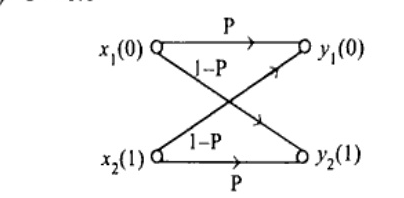
7 MarksbFor a BSC shown in fig. 1 find the channel capacity for
- i)P = 0.9
- ii)P = 0.6
How to answer
- BSC capacity formula C = 1 - H(P) where H is binary entropy
- Calculation for P=0.9 using H(0.9)
- Calculation for P=0.6 using H(0.6)
- Interpretation of capacity values
-
14 MarksWrite short notes on any two of the following:
- a)Gram Schmidt Orthogonalisation
- b)Error probability of QAM
- c)Cyclic codes
How to answer
- Brief principle, steps / expression for each chosen topic
- Relevant block diagram / formula / example
- Applications / significance
- Conclusion for each short note
Go to where you left off?
Quick Add to Notes
Save questions, your own notes and screenshots into notes filed by unit. It takes a free account.
Create free accountHave an account? Log in
Notes Panel