CY-502 · Design& Analysis of Algorithms/Unsolved PYQ Paper
CY-502 Design and Analysis of Algorithm - Dec 2025 Question Paper
Under each question, How to answer lists the points an answer should cover, outlined by CampusPrep from the syllabus. Check the details against your textbook.
-
7 MarksaDefine an algorithm. Explain time and space complexity and the concept of time-space tradeoff.
How to answer
- Define algorithm: finite, definite, effective steps
- Define time complexity and space complexity with examples
- Explain time-space tradeoff concept with example
-
7 MarksbExplain asymptotic notations $O$, $\Omega$ and $\Theta$ with suitable examples.
How to answer
- Define Big-O, Omega, Theta formally
- Give mathematical definitions with inequalities
- Provide suitable example for each notation
-
7 MarksaExplain recurrence relations and methods to solve them.
How to answer
- Define recurrence relation in algorithm analysis
- Explain substitution method
- Explain recursion-tree method and Master method
-
7 MarksbSolve the recurrence, $T(n)=2T(n/2) + n$ using Master's methods.
How to answer
- Identify a=2, b=2, f(n)=n for Master theorem
- Compute $n^{\log_b a}$ and compare with f(n)
- Apply Case 2 to get $T(n)=\Theta(n \log n)$
-
7 MarksaExplain the divide and conquer technique with reference to merge sort.
How to answer
- Explain divide, conquer, combine phases
- Explain merge sort procedure with example
- Give recurrence and $O(n \log n)$ complexity
-
7 MarksbApply binary search to find 25 in the sorted array, $[5, 10, 15, 20, 25, 30, 35]$. Show the steps.
How to answer
- Start with low=0, high=6, find mid
- Compare mid element with 25 and adjust bounds
- Show steps until 25 found at index 4
-
7 MarksaExplain the greedy method. Discuss its strategy and characteristics.
How to answer
- Define greedy method and greedy choice
- Explain strategy: local optimum, feasibility, irrevocable
- List characteristics: greedy-choice property, optimal substructure
-
7 MarksbConstruct a minimum spanning tree using Kruskal's algorithm for the given graph as shown in FIGURE (A) as mentioned below.
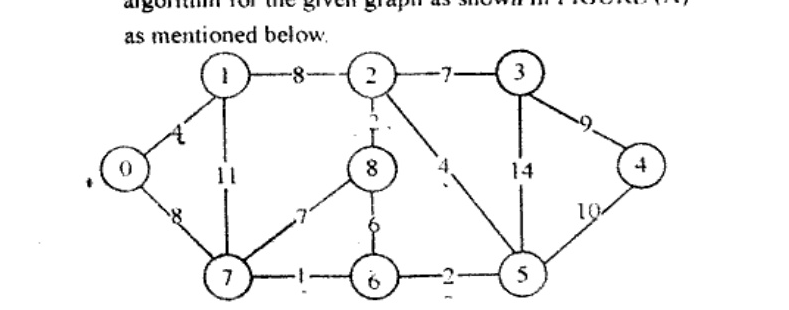
How to answer
- List all edges of FIGURE (A) sorted by weight
- Iteratively add least-weight edge avoiding cycle
- Obtain MST and compute total minimum cost
-
7 MarksaExplain dynamic programming and its characteristics.
How to answer
- Define dynamic programming and principle of optimality
- Explain overlapping subproblems and memoization
- List characteristics with example
-
7 MarksbSolve the 0/1 knapsack problem for weights $\{2, 3, 4\}$, values $\{1, 2, 5\}$ and capacity $= 5$.
How to answer
- Build DP table for weights {2,3,4}, values {1,2,5}, capacity 5
- Evaluate optimal value by considering include/exclude
- Trace back optimal item set and maximum profit
-
7 MarksaExplain the concept of backtracking with reference to the 8-queens problem.
How to answer
- Define backtracking and state-space tree
- Explain constraints for 8-queens: row, column, diagonal
- Describe recursive placement and backtrack steps
-
7 MarksbApply the Branch and Bound algorithm to solve the travelling salesperson problem for the given graph as shown in FIGURE (B)
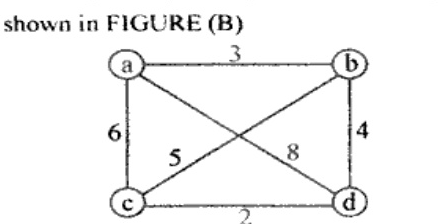
How to answer
- Formulate TSP cost matrix from FIGURE (B)
- Apply Branch and Bound: compute bounds and expand nodes
- Identify minimum-cost tour and its cost
-
7 MarksaExplain NP-hard and NP-complete problems with suitable examples.
How to answer
- Define NP, NP-hard with reducibility concept
- Define NP-complete with NP + NP-hard
- Give examples e.g. SAT, TSP, Vertex Cover
-
7 MarksbWhat are approximation algorithms? Explain their need and applications.
How to answer
- Define approximation algorithms and ratio bound
- Explain need: NP-hard problems, large inputs
- Give applications e.g. TSP, Vertex Cover, scheduling
-
7 MarksaDiscuss advanced tree and graph algorithms. Explain the importance of shortest path algorithms.
How to answer
- Discuss advanced tree/graph models
- Explain Dijkstra, Bellman-Ford, Floyd-Warshall
- Highlight importance of shortest path in networks
-
7 MarksbWrite short notes on data stream algorithms and parallel algorithms.
How to answer
- Define data stream algorithms: single-pass, sublinear space
- Define parallel algorithms: speedup, PRAM
- Give applications and examples for both
Go to where you left off?
Quick Add to Notes
Save questions, your own notes and screenshots into notes filed by unit. It takes a free account.
Create free accountHave an account? Log in
Notes Panel