BT-204 · Basic Civil Engineering & Mechanics/Unsolved PYQ Paper
BT-204 Basic Civil Engineering and Engineering Mechanics - Nov 2022 Question Paper
Under each question, How to answer lists the points an answer should cover, outlined by CampusPrep from the syllabus. Check the details against your textbook.
-
7 MarksaWrite about physical and chemical properties of concrete.
How to answer
- Physical properties: Workability, compressive strength, tensile strength, elasticity, creep, shrinkage, durability, permeability.
- Chemical properties: Hydration of cement, alkali-aggregate reaction, sulfate attack, carbonation, resistance to acids/chlorides.
-
7 MarksbExplain about the different types of stair case used in building construction with a neat sketch
How to answer
- Definition and purpose of staircase in buildings.
- Classification: Straight, Dog-legged, Open-well (Open-newel), Quarter-turn, Bifurcated, Spiral/Helical stairs.
- Brief explanation of features of each type.
- Neat sketches/plans of major types (especially dog-legged and open-well).
-
7 MarksaExplain the individual component of the Theodolite with a Sketch.
How to answer
- Neat labeled diagram of transit theodolite showing essential parts.
- Explanation of components: Trivet and Tribrach, Levelling head/screws, Lower and Upper plates with verniers, Standards (A-frame), Telescope, Vertical circle, Plate levels, Compass, Plumb bob.
-
7 MarksbNarrate about the classification of stone used in construction industry.
How to answer
- Geological classification: Igneous (granite, basalt), Sedimentary (sandstone, limestone), Metamorphic (marble, slate, quartzite).
- Physical classification: Stratified, Unstratified, Foliated.
- Chemical classification: Siliceous, Argillaceous, Calcareous.
- Practical engineering uses of each classification.
-
7 MarksaExplain in brief with about the Remote sensing and its application in construction
How to answer
- Definition and basic principle of remote sensing.
- Components: Energy source, sensor, platform, data transmission, processing.
- Applications in construction: Site investigation and planning, alignment of roads/railways, monitoring construction progress, water resources management, structural health monitoring, environmental impact assessment.
-
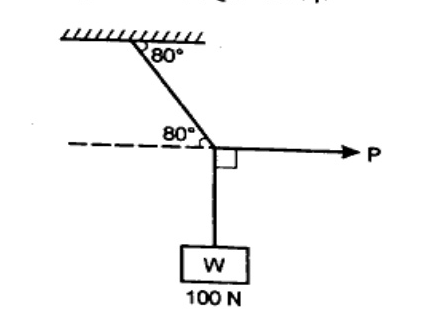
7 MarksbState and derive the Lami's theorem and solve the problem given below using the theorem
How to answer
- Statement of Lami's theorem.
- Derivation using force triangle and law of sines.
- Identification of forces acting at the junction: Tension $T$ in inclined cable, horizontal force $P$, and vertical load $W = 100\text{ N}$.
- Calculate angles between each pair of forces.
- Apply Lami's theorem equation to solve for $P$ and string tension.
-
7 MarksaDiscuss us about the Contour line, Contour Interval, Horizontal Interval and Use of Contour Map
How to answer
- Definition of Contour line: Line joining points of equal elevation.
- Definition of Contour interval: Constant vertical distance between consecutive contours.
- Definition of Horizontal interval / equivalent: Horizontal distance between two consecutive contour lines.
- Uses of contour maps: Route selection, reservoir capacity determination, intervisibility, earthwork volume calculation, geological features identification.
-
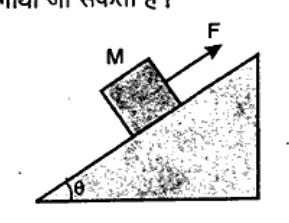
7 MarksbA block of mass $M = 10\text{ kg}$ is sitting on a surface inclined at angle $\theta = 45^\circ$. Given that the coefficient of static friction is $\mu_s = 0.5$ between block and surface, what is the minimum force $F$ necessary to prevent slipping? What is the maximum force $F$ that can be exerted without causing the block to slip?
How to answer
- Free body diagram with normal reaction $R = Mg\cos(45^\circ)$ and limiting friction $f_s = \mu_s R$.
- Case 1 (impending downward slip): $F_{\min} + f_s = Mg\sin(45^\circ) \implies F_{\min} = Mg(\sin 45^\circ - \mu_s \cos 45^\circ)$.
- Case 2 (impending upward slip): $F_{\max} = Mg\sin(45^\circ) + f_s = Mg(\sin 45^\circ + \mu_s \cos 45^\circ)$.
- Calculate numerical values using $g = 9.81\text{ m/s}^2$ (or $9.8\text{ m/s}^2$).
- $F_{\min} \approx 34.68\text{ N}$, $F_{\max} \approx 104.05\text{ N}$.
-
7 MarksaIllustrate the difference between the Height of Collimation and Rise and Fall Method
How to answer
- Tabular comparison between Collimation method and Rise & Fall method.
- HI method calculates height of instrument at each setup; intermediate RLs found by $HI - IS$. Faster, but no check on intermediate sights.
- Rise and Fall method calculates relative rise/fall between consecutive points. Provides complete arithmetic check on intermediate stations.
- Formulas for arithmetic checks for both methods.
-
7 MarksbThe following are the consecutive reading were taken with a levelling instrument at intervals of $20\text{ m}$. $2.375$, $1.730$, $0.615$, $3.450$, $2.835$, $2.070$, $1.835$, $0.985$, $0.435$, $1.630$, $2.255$ and $3.630\text{ m}$. The instrument was shifted after the fourth and eight reading. The last reading was taken on a BM of RL $110.200\text{ m}$. Find the RLs of all the point using Rise and Fall method and satisfy the answer with arithmetic Check.
How to answer
- Set up Level Book columns: Station, Chainage, BS, IS, FS, Rise, Fall, RL, Remarks.
- Classify readings: 1st setup: BS=2.375, IS=1.730, IS=0.615, FS=3.450 (4th reading); 2nd setup: BS=2.835, IS=2.070, IS=1.835, FS=0.985 (8th reading); 3rd setup: BS=0.435, IS=1.630, IS=2.255, FS=3.630 (12th reading).
- Compute Rise and Fall for each interval.
- Work backwards from the known last RL ($110.200\text{ m}$) or find first RL and forward calculate all RLs.
- Apply arithmetic check: $\sum BS - \sum FS = \sum Rise - \sum Fall = \text{Last RL} - \text{First RL}$.
-
6 MarksaDifferentiate the difference between Moment of inertia and Product of inertia.
How to answer
- Definition: $I_{xx} = \int y^2 dA$ (always positive) vs $I_{xy} = \int xy dA$ (can be positive, negative, or zero).
- Physical meaning: Moment of inertia measures resistance to bending/rotation; Product of inertia is a measure of asymmetry about the coordinate axes.
- Significance of symmetry: If either the x or y axis is an axis of symmetry, $I_{xy} = 0$.
- Relation to principal axes.
-
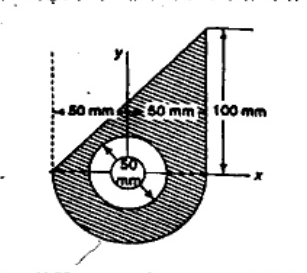
8 MarksbCalculate the Moment of Inertia about the X- axis.
How to answer
- Divide shaded composite area into standard components: Right triangular area in upper quadrant, semicircular lower area, minus the circular hole.
- State dimensions from diagram: Semicircle of radius $50\text{ mm}$ below X-axis, right triangle of base $50\text{ mm}$ and height $100\text{ mm}$ above X-axis, central circular hole of diameter $50\text{ mm}$.
- Compute $I_x$ of each component about the X-axis directly or via parallel axis theorem.
- Sum individual contributions: $I_{xx} = I_{x,\text{triangle}} + I_{x,\text{semicircle}} - I_{x,\text{hole}}$.
- Final value in $\text{mm}^4$.
-
6 MarksaWrite about the difference between Method of Joint and Method of Section.
How to answer
- Method of Joints: Evaluates equilibrium of individual concurrent force systems at joints; uses $\sum F_x = 0, \sum F_y = 0$; best when all member forces are needed.
- Method of Sections: Cuts the truss into two sections; uses non-concurrent coplanar equilibrium $\sum F_x = 0, \sum F_y = 0, \sum M = 0$; ideal for determining forces in specific internal members without solving the entire truss.
- Tabular comparison outlining advantages and limitations of each.
-
8 MarksbDraw the Shear force and Bending moment diagram for the simple supported beam carries a Uniform distributed load of intensity "W" kN/m throughout a span of length "L" m.
How to answer
- Calculate support reactions: $R_A = R_B = \frac{WL}{2}$.
- Write shear force equations along length $x$: $V_x = \frac{WL}{2} - Wx$; value at ends $\pm \frac{WL}{2}$, zero at $x = \frac{L}{2}$.
- Write bending moment equations: $M_x = \frac{WL}{2}x - \frac{Wx^2}{2}$; zero at supports, parabolic variation.
- Maximum bending moment occurs at mid-span: $M_{\max} = \frac{WL^2}{8}$.
- Draw neat, labeled SFD (linear slope) and BMD (parabolic curve).
-
14 MarksExplain about the following Terms:
- a)Centroid and Centre of Gravity
- b)Profile Cross-sectioning
- c)Plane table and its used instruments
How to answer
- a) Centroid (geometric center of 1D/2D shapes) vs Centre of Gravity (point where total weight acts in 3D bodies). (5 marks)
- b) Profile Cross-sectioning: Longitudinal and transverse leveling along a proposed route (road/canal/rail) to determine ground profile and earthwork quantities. (5 marks)
- c) Plane table and accessories: Drawing board, tripod, alidade, trough compass, plumbing fork with plumb bob, spirit level. (4 marks)
Go to where you left off?
Quick Add to Notes
Save questions, your own notes and screenshots into notes filed by unit. It takes a free account.
Create free accountHave an account? Log in
Notes Panel