CS-601 · Machine Learning/Unsolved PYQ Paper
CS-601 Machine Learning - May 2023 Question Paper
Under each question, How to answer lists the points an answer should cover, outlined by CampusPrep from the syllabus. Check the details against your textbook.
-
7 MarksaExplain various types of machine learning used for continuous data and non-continuous data.
How to answer
- Define supervised, unsupervised, semi-supervised, reinforcement learning
- Distinguish continuous data - regression, time-series vs non-continuous / discrete / categorical - classification, clustering
- Give example algorithms for each type
-
7 MarksbGive an explanation of the One-hot encoding as well as the Label encoding. In what ways do they change the dimensionality of the data that has been provided?
How to answer
- Define One-hot encoding with example vector
- Define Label encoding with example integers
- Compare effect on dimensionality - expansion vs same dimension and implications
-
7 MarksaBreak down how CNN actually operates. The image is downscaled, and the number of filters is increased as we approach the model's output, but why?
How to answer
- Outline convolution, activation, pooling, fully connected stages
- Explain spatial downsampling and hierarchical feature learning
- Explain why filters increase - more abstract features, compensate spatial loss, control parameters
-
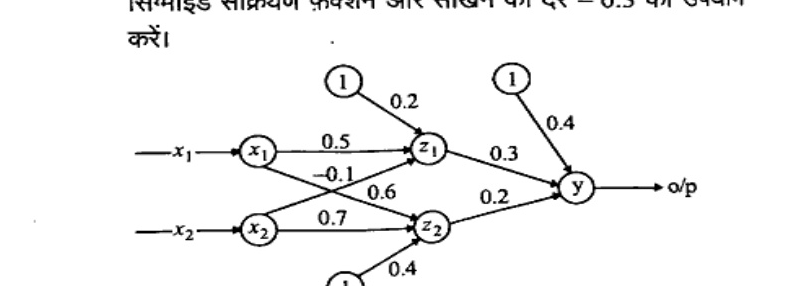
7 MarksbReplace the old weights (not the bias) in the network depicted in the following figure using back-propagation algorithms. A [0,1] input pattern is given to the network, and the desired output is 1. Use the Sigmoid activation function and a learning rate of = 0.3.
How to answer
- Compute forward pass with sigmoid for z1, z2, y for input [0,1]
- Compute output error and backpropagate deltas to hidden and input layers
- Update weights with learning rate 0.3 using gradient descent rule
-
7 MarksaDescribe the benefits of transfer learning features that can be transferred. Explain Inception net architecture in detail
How to answer
- Define transfer learning and transferable features - early layers, embeddings
- List benefits - less data, faster training, better generalization
- Explain Inception net - inception modules, 1x1 convolutions, GoogLeNet structure
-
7 MarksbWhat are the structural and operational differences between a feed-forward network and a recurrent neural network? Identify the differences between LSTM, GRU, and vanilla RNNs.
How to answer
- Compare feed-forward acyclic vs recurrent cyclic with feedback and memory
- Explain operation on sequential data vs static input
- Differentiate LSTM gates, GRU simplified gates, vanilla RNN vanishing gradient
-
14 MarksDifferentiate:
- i)Various loss functions
- ii)Types of Gradient Descent Optimizers
How to answer
- Define loss functions - MSE, cross-entropy, hinge etc. with use cases
- Define gradient descent variants - batch, stochastic, mini-batch, Adam, RMSprop etc.
- Tabulate differences on computation, convergence, memory
-
7 MarksaClarify the meaning of Confusion metrics in the context of machine learning. What other metrics might be derived from the metric of confusion?
How to answer
- Define confusion matrix - TP, TN, FP, FN
- Explain accuracy, precision, recall, F1 derived from it
- Give example of imbalanced data use
-
7 Marksb"Model performance can be greatly improved through careful hyperparameter tuning". Justify the statement.
How to answer
- Define hyperparameters vs parameters with examples
- Explain tuning methods - grid, random, Bayesian search
- Justify impact on performance with overfitting/underfitting example
-
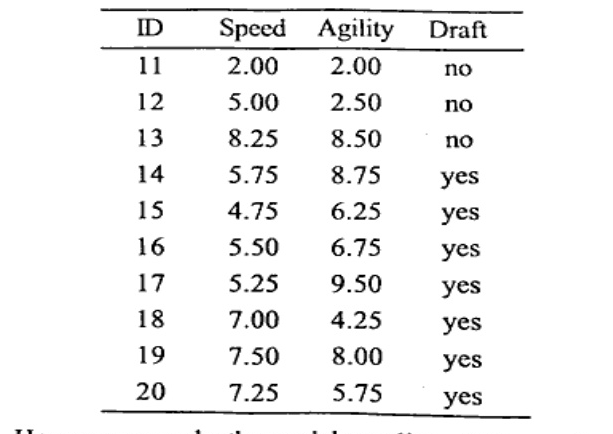
7 MarksaExplain how the KNN method is implemented. Below is information regarding a player's speed and agility that will be used to determine whether he will be drafted into the team. Predict the likelihood that a player with "speed = 6.75" and "agility = 3" will make the team using the KNN machine learning model assuming "k = 3".
How to answer
- Outline KNN steps - distance metric, choose k, majority vote
- Compute Euclidean distances for speed=6.75, agility=3 to all IDs
- Identify 3 nearest neighbours and predict Draft yes/no
-
7 MarksbHow can we make the model non-linear? If we only use linearity, how will that affect Gradient Descent?
How to answer
- Explain role of non-linear activation functions - ReLU, sigmoid, tanh
- Show linear-only network collapses to linear model
- Explain effect on gradient descent - convex vs non-convex, representational power
-
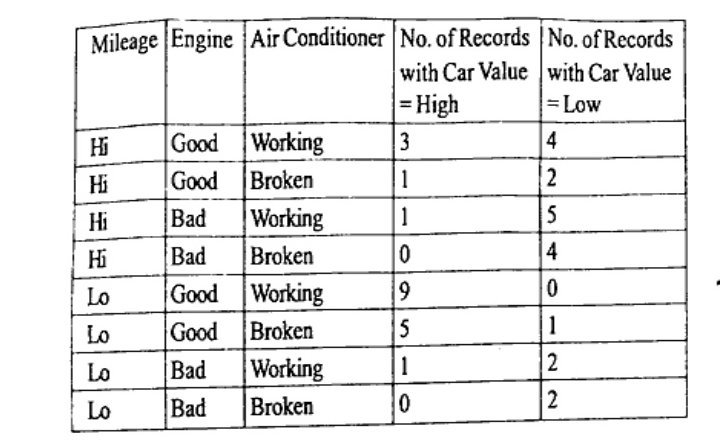
7 MarksaBased on figure, which depicts the Bayesian belief network for the data set shown in the table below, respond to the following questions. (Assume that each attribute has a binary value.) https://www.rgpvonline.com
- i)Draw the probability table for each node in the network.
- ii)Use the Bayesian network to predict the 'car value' for the following. P(Mileage = Lo, Engine = Bad, Air Conditioner = Broken)
How to answer
- Compute prior and conditional probabilities from counts table for Mileage, Engine, Air Conditioner, Car Value
- Draw CPTs per Bayesian belief network structure
- Apply chain rule to predict P for Mileage=Lo, Engine=Bad, Air Conditioner=Broken
-
7 MarksbDescribe the procedure that can be used to identify overfitting and underfitting in a CNN model. Include some potential solutions to this problem as well.
How to answer
- Define overfitting vs underfitting via training vs validation loss curves
- Describe detection procedure - split, learning curves, metrics
- List solutions - regularization, dropout, augmentation, early stopping, more data
-
14 MarksExplain the following with an appropriate example:
- i)Computer Vision
- ii)Reinforcement learning
How to answer
- Define Computer Vision with CNN example - image classification, detection
- Define Reinforcement learning - agent, environment, reward with game/robot example
- Give appropriate real-world example for each
Go to where you left off?
Quick Add to Notes
Save questions, your own notes and screenshots into notes filed by unit. It takes a free account.
Create free accountHave an account? Log in
Notes Panel