CS-303 · Data Structure/Unsolved PYQ Paper
CS-303 Data Structures - Jun 2023 Question Paper
Under each question, How to answer lists the points an answer should cover, outlined by CampusPrep from the syllabus. Check the details against your textbook.
-
7 MarksaWhat are the different abstract data types? Explain.
How to answer
- Definition of Abstract Data Type (ADT)
- Separation of interface and implementation
- Key examples: List ADT, Stack ADT, Queue ADT, Tree ADT, Graph ADT
- Operations defined for common ADTs
-
7 MarksbWhat is a linked list .explain its operations with examples.
How to answer
- Definition of linked list (node structure with data and pointer/next)
- Basic operations: Insertion (beginning, end, given position), Deletion, Traversal, Search
- Diagrammatic representation of nodes and pointers
- Example of performing operations on a sample list
-
7 MarksaDifferentiate between the stack and queue.
How to answer
- Tabular comparison between stack and queue
- Order of processing (LIFO vs FIFO)
- Endpoints/pointers (Single end - Top vs Two ends - Front and Rear)
- Operations: push/pop vs enqueue/dequeue
- Common real-world and computational applications
-
7 MarksbWrite a 'C' program to convert the infix expression to postfix expression.
How to answer
- Algorithm for infix to postfix conversion using a stack
- Definitions of precedence function and stack helper functions (push, pop, isEmpty)
- Complete C program reading an infix string and outputting postfix string
- Handling of '(' and ')' properly
-
7 MarksaWrite an algorithm for insert and delete operations in circular linked list.
How to answer
- Definition/structure of circular linked list
- Step-by-step algorithm for insertion (at beginning / at end)
- Step-by-step algorithm for deletion (from beginning / from end / specific node)
- Pointer updating logic to maintain circularity
-
7 MarksbHow a binary search tree is traversed? Explain with a suitable example.
How to answer
- Definition of BST property
- Traversal techniques: Inorder (Left, Root, Right), Preorder (Root, Left, Right), Postorder (Left, Right, Root)
- Note that inorder traversal gives elements in ascending order
- Example BST drawn with computed traversals
-
14 MarksInsert the following list of elements from the avl tree . Delete the elements 18, 2, 30 from the 12, 30, 36, 18, 25, 9, 4, 2, 17, 14, 20 and 47.
How to answer
- Step-by-step insertion of elements: 12, 30, 36, 18, 25, 9, 4, 2, 17, 14, 20, 47 showing rotations (LL, RR, LR, RL) when balance factor exceeds $\pm 1$
- Intermediate and final AVL tree diagrams after complete insertion
- Step-by-step deletion of 18, then 2, then 30
- Perform rotations if tree becomes unbalanced after each deletion and draw the resulting AVL trees
-
7 MarksaWhat is heap data structure ?explain its operations with a suitable example.
How to answer
- Definition of heap (complete binary tree satisfying heap property)
- Difference between Min-heap and Max-heap
- Operations: Insert, Delete (extract-max/min), Heapify
- Step-by-step example with diagrams showing insertion and deletion
-
7 MarksbSort the following list of elements 30, 56, 78, 99, 12, 43, 10, 24, 85 by using merge sort.
How to answer
- Divide array into two halves recursively until single elements remain
- Show recursive division tree for [30, 56, 78, 99, 12, 43, 10, 24, 85]
- Show step-by-step merge passes combining sorted sub-arrays
- Final sorted list: 10, 12, 24, 30, 43, 56, 78, 85, 99
-
7 MarksaCompare and contrast bfs and dfs.
How to answer
- Tabular comparison between BFS and DFS
- Data structures: Queue for BFS, Stack (or recursion) for DFS
- Traversal strategy: Level-order vs backtracking along deep branches
- Time and space complexities
- Typical use cases for each
-
7 MarksbDiscuss kruskals algorithm with an following graph.
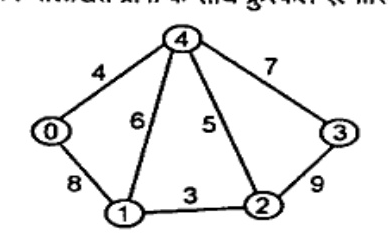
How to answer
- Explain Kruskal's algorithm steps (sort edges, iteratively add minimum edge if it doesn't form a cycle)
- List of all edges sorted by weight: (1,2): 3, (0,4): 4, (4,2): 5, (4,1): 6 (rejected, forms cycle 1-2-4), (4,3): 7, etc.
- Step-by-step edge selection and cycle detection
- Edges included in MST: (1,2), (0,4), (4,2), (4,3)
- Calculate total minimum weight = 3 + 4 + 5 + 7 = 19
- Draw the resulting MST
-
7 MarksaExplain shell sort algorithm and simulate it for the following data 35, 33, 42, 10, 14, 19, 27, 44.
How to answer
- Explain shell sort concept (generalized insertion sort with gap sequence $h$)
- Choose initial gap, e.g., $gap = \lfloor N/2 \rfloor = 4$
- Show array after pass with gap = 4
- Show array after pass with gap = 2
- Show final pass with gap = 1 (standard insertion sort on nearly sorted array)
- Final sorted sequence: 10, 14, 19, 27, 33, 35, 42, 44
-
7 MarksbExplain sequential search and simulate it for the following data 4, 21, 36, 14, 62, 91, 8, 22, 81, 77, 10.
How to answer
- Explain sequential/linear search mechanism and algorithm
- State time complexity: Best case $O(1)$, Worst/Average case $O(n)$
- Simulate searching for an element present (e.g., key = 8) showing comparisons from index 0
- Simulate searching for an element not present or at the end
-
14 MarksWrite short notes on any two of the following:
- i)Stack using linked list
- ii)Indexing
- iii)B tree
- iv)Priority queue
How to answer
- For Stack using linked list: Node structure, push and pop at head node, advantages over array implementation
- For Indexing: Concept of index records, dense vs sparse index, primary vs secondary indices to speed retrieval
- For B tree: Self-balancing multiway search tree, properties (order m, min/max keys, balanced height), search/insertion basics
- For Priority queue: Definition, elements with priority keys, operations (insert, extract-max/min), heap-based implementation
Go to where you left off?
Quick Add to Notes
Save questions, your own notes and screenshots into notes filed by unit. It takes a free account.
Create free accountHave an account? Log in
Notes Panel