CE-604 (D) · Operation Research/Unsolved PYQ Paper
CE-604-D Operation Research - May 2022 Question Paper
Under each question, How to answer lists the points an answer should cover, outlined by CampusPrep from the syllabus. Check the details against your textbook.
-
7 MarksaExplain the characteristics of operation research and state the limitations of O.R. models.
How to answer
- Define OR and its interdisciplinary decision-making nature
- List characteristics: system orientation, mathematical models, optimization, etc.
- State limitations of OR models: assumptions, data, cost, human factors
-
7 MarksbUse simplex method to solve the following Linear programming problem: Maximize $Z = 3x_1 + 7x_2$, subject to constraints $$2x_1 + 5x_2 <= 20$$ $$x_1 + 2x_2 <= 4$$ $$x_1 >= 0, x_2 >= 0$$
How to answer
- Convert to standard form with slack variables
- Construct initial simplex tableau
- Iterate to optimality and read $x_1, x_2, Z_{max}$
-
7 MarksaWhat is degeneracy in Transportation Problem? Discuss its consequence and how it is overcome?
How to answer
- Define degeneracy: occupied cells < m+n-1
- Explain consequences: loss of optimality test, looping
- Explain overcoming by epsilon allocation / perturbation
-
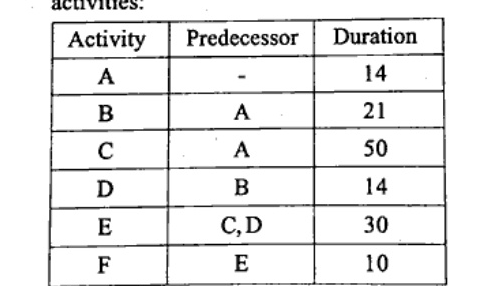
7 MarksbA project being planned involved the following activities:
- i)Construct the network diagram and find out critical path and project completion time.
- ii)Determine expected project completion time.
- iii)Determine free slack and total slack
How to answer
- Draw AOA network from predecessors
- Forward/backward pass to find critical path and duration
- Compute total slack and free slack for activities
-
14 MarksSBC, a company that buys alarm clocks from a manufacturer and distributes to retailers. SBC would like to reduce its inventory cost by determining the optimal number of alarm clocks to obtain per order. The annual demand is 1,000 units, the ordering cost is $10 per order and the carrying cost is $0.50 per unit per year. Each alarm clock has a purchase cost of $5. How many clocks should SBC order each time?
How to answer
- Identify EOQ model: $Q^* = \sqrt{2DC_o/C_h}$
- Substitute D=1000, Co=10, Ch=0.50
- Compute optimal order quantity and interpretation
-
7 MarksaBriefly explain queuing systems and its characteristics.
How to answer
- Define queuing system and arrival-service-queue components
- List characteristics: arrival pattern, service mechanism, queue discipline
- Give examples of Kendall notation
-
7 MarksbA postal clerk can service a customer in 3 minutes. The service time is being exponentially distributed. The inter arrival time of customers is also exponentially distributed with an average of 12 minutes during early morning slack period and an average of 5 minutes during the afternoon peak period. Assess the average queue length and the expected waiting time in the queue during the two periods.
How to answer
- Compute service rate mu and arrival rates lambda for two periods
- Apply M/M/1 formulas $L_q = \lambda^2/\mu(\mu-\lambda)$, $W_q = L_q/\lambda$
- Compare slack vs peak period queue length and waiting time
-
7 MarksaA Police Station employs 30 police officers. Each officer works for 5 days per week. The crime rate fluctuates with the day of week, so the number of the police officers required each day depends on which day of the week it is: Monday, 18; Tuesday, 24; Wednesday, 25; Thursday, 16; Friday, 21; Saturday, 28; Sunday, 18. The Police Station wants to schedule police officers to minimize the number whose days off are not consecutive. Formulate an LP that will accomplish this goal.
How to answer
- Define decision variables for officers starting each day
- Formulate covering constraints for Mon-Sun requirements
- State objective to minimize non-consecutive offs / total officers
-
7 MarksbExplain the following terms:
- i)Pay off matrix
- ii)Fair Game
- iii)Rule of dominance
- iv)Saddle Point
How to answer
- Define pay-off matrix with example
- Define fair game and value zero
- Explain dominance rule and saddle point
-
7 MarksaSolve the given problem using Big-M method: Minimize $Z = 12x_1 + 20x_2$; subject to constraints; $$6x_1 + 8x_2 >= 100$$ $$7x_1 + 12x_2 >= 120$$ $$x_1, x_2 >= 0$$
How to answer
- Convert >= constraints with surplus and artificial variables
- Form Big-M objective with penalty M
- Iterate simplex to optimal $x_1, x_2, Z_{min}$
-
7 MarksbDefine:
- i)Basic Feasible Solution
- ii)Optimal Solution
- iii)Un-bound solution
How to answer
- Define BFS with m non-zero basic variables
- Define optimal solution as feasible with best objective
- Define unbounded solution with infinite objective
-
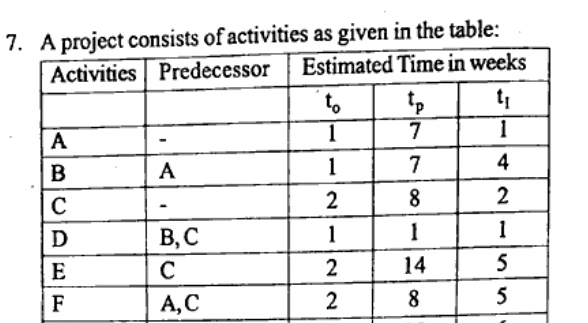
14 MarksA project consists of activities as given in the table:
- i)Draw the Project network.
- ii)Identify the critical path and determine the expected completion time for project.
- iii)What is the probability that project would be completed in 17 weeks.
How to answer
- Compute expected time $t_e=(t_o+4t_m+t_p)/6$ and variance
- Draw network and find critical path and $T_e$
- Compute Z for 17 weeks and find probability from normal table
-
14 MarksExplain in brief the following terms related to 'Service discipline' with examples.
- i)FIFO
- ii)LIFO
- iii)Priority Service
- iv)Random Service
How to answer
- Define FIFO with queue example
- Define LIFO with stack example
- Explain priority and random service with examples
Go to where you left off?
Quick Add to Notes
Save questions, your own notes and screenshots into notes filed by unit. It takes a free account.
Create free accountHave an account? Log in
Notes Panel