AL-501 · Operating Systems/Unsolved PYQ Paper
AL-501 Operating Systems - Nov 2022 Question Paper
Under each question, How to answer lists the points an answer should cover, outlined by CampusPrep from the syllabus. Check the details against your textbook.
-
7 MarksaDescribe the evolution of the operating system in detail.
How to answer
- Define operating system and need for evolution
- Serial/batch processing and multiprogramming
- Time-sharing, personal, parallel, distributed and real-time systems
- Modern OS features and summary
-
7 MarksbWhat are the major services of an operating system with regard to process management? Explain.
How to answer
- Define process management role of OS
- List services: creation, scheduling, synchronization, communication, deadlock handling
- Explain each service briefly
- Importance with example
-
14 MarksExplain different disk allocation methods in detail.
How to answer
- Define disk allocation and file allocation problem
- Explain contiguous allocation with merits/demerits
- Explain linked and indexed allocation
- Comparison and examples
-
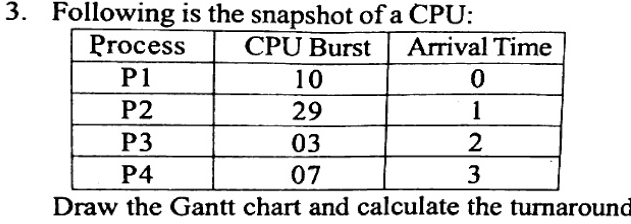
14 MarksFollowing is the snapshot of a CPU: Draw the Gantt chart and calculate the turnaround time and waiting time of the jobs for
- i)FCFS (First Come First Served)
- ii)SJF (Shortest Job First)
- iii)SRTF (Shortest Remaining Time First)
- iv)RR (Round Robin with time quantum 10) scheduling algorithms
How to answer
- Tabulate arrival and burst times for P1-P4
- Draw Gantt charts for FCFS, SJF, SRTF, RR quantum 10
- Calculate turnaround time = completion - arrival and waiting time
- Compare average times across algorithms
-
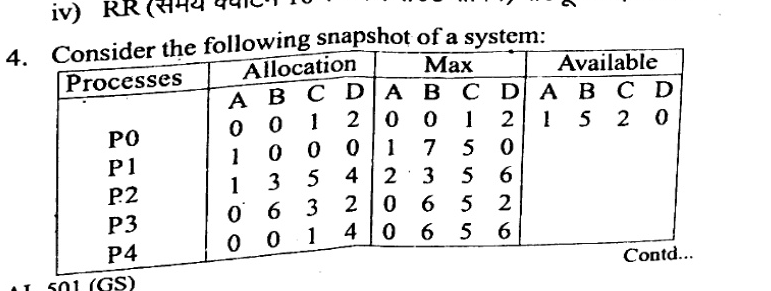
14 MarksConsider the following snapshot of a system: Answer the following questions using the banker's algorithm:
- i)What is the content of the matrix Need?
- ii)Is the system in a safe state?
- iii)If a request from process P1 arrives for (0, 4, 2, 0) can the request be granted immediately?
How to answer
- Compute Need = Max - Allocation matrix
- Apply Banker's safety algorithm to find safe sequence
- Check request (0,4,2,0) of P1 against Need and Available
- Decide grant and new safe state
-
7 MarksaWhat is Demand paging? Explain.
How to answer
- Define demand paging and lazy loading concept
- Explain page fault handling steps
- Advantages and performance with effective access time
- Diagram of demand paging
-
7 MarksbDiscuss about segmentation with an example.
How to answer
- Define segmentation and segments
- Explain segment table with base and limit
- Illustrate with example and address translation
- Advantages over paging
-
7 MarksaDifferentiate Synchronous and Asynchronous I/O operations. https://www.rgpvonline.com
How to answer
- Define synchronous I/O with blocking behavior
- Define asynchronous I/O with non-blocking behavior
- Compare on waiting, concurrency, implementation
- Examples of each
-
7 MarksbHow I/O request are transferred to hardware devices?
How to answer
- Outline I/O request lifecycle from application
- Explain system call, driver, controller steps
- Role of interrupts and DMA
- Path to hardware device
-
7 MarksaConsider the page reference string 1, 0, 2, 5, 3, 0, 1, 0, 2, 4, 0, 3, 0, 4, 2, 4, 3, 4, 1, 4, 0. How many page faults occur for the Optimal and LRU Page replacement algorithms with 4 frames each?
How to answer
- State reference string and 4 frames assumption
- Simulate Optimal replacement counting faults
- Simulate LRU replacement counting faults
- Compare fault counts
-
7 MarksbDescribe the actions taken by a thread library to context-switch between user level threads.
How to answer
- Define user-level threads and thread library
- Steps to save current thread context (registers, stack)
- Steps to restore next thread context without kernel trap
- Role of scheduler in library
-
14 MarksWrite short notes on any two:
- a)Mutual Exclusion
- b)Disk Mounting
- c)Virtual File Systems
- d)User level and Kernel level threads
How to answer
- Select any two topics from four options
- Define each with key principles and example
- Explain advantages/applications
- Neat diagram where applicable
Go to where you left off?
Quick Add to Notes
Save questions, your own notes and screenshots into notes filed by unit. It takes a free account.
Create free accountHave an account? Log in
Notes Panel