BT-401 · Mathematics-III/Unsolved PYQ Paper
BT-401 Mathematics - III - Nov 2022 Question Paper
Under each question, How to answer lists the points an answer should cover, outlined by CampusPrep from the syllabus. Check the details against your textbook.
-
7 MarksaBy using Newton Raphson method, find the root of $x^4-x-10=0$. Which is nearer to $x = 2$, correct to three places of decimals.
How to answer
- State Newton-Raphson formula $x_{n+1}=x_n-f(x_n)/f'(x_n)$ with $f(x)=x^4-x-10$.
- Take initial $x_0=2$ and compute $f$ and $f'=4x^3-1$ iterations.
- Iterate till three decimal stability.
- Report root nearer to 2 correct to three decimals.
-
7 MarksbProve that: $(I + \Delta)(I - \nabla) \equiv \Delta\nabla$
How to answer
- Define forward $\Delta$, backward $\nabla$, shift $E$ and identity $I$ operators.
- Use relations $E = 1+\Delta = (1-\nabla)^{-1}$.
- Expand LHS $(I+\Delta)(I-\nabla)$.
- Show it equals $\Delta\nabla$.
-
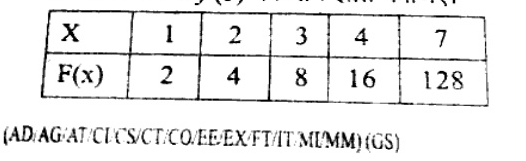
7 MarksaFind the value of $f(5)$ from the following table.
How to answer
- Note unequal intervals with $x=1,2,3,4,7$; choose Newton's divided difference.
- Construct divided difference table.
- Write interpolation polynomial and put $x=5$.
- Compute $f(5)$.
-
7 MarksbFind the real root of the equation $x \log_{10}x - 1.2 = 0$ correct to five places of decimal by Regula Falsi Method.
How to answer
- Define $f(x)=x\log_{10}x-1.2$ and locate root interval.
- State Regula Falsi formula $x_2 = x_0 - f(x_0)(x_1-x_0)/(f(x_1)-f(x_0))$.
- Iterate until five decimal accuracy.
- Report real root.
-
7 MarksaGiven following data, find the value of the following integral using simpson's 1/3 rule and compare it with the actual value. $$\int_0^4 e^x dx$$ $[e^0=1, e^1=2.72, e^2=7.39, e^3=20.09, e^4=54.60]$
How to answer
- State Simpson's 1/3 rule with $h=1$ for $\int_0^4 e^x dx$.
- Substitute $e^0=1, e^1=2.72, e^2=7.39, e^3=20.09, e^4=54.60$.
- Compute approximate integral.
- Compare with exact value $e^4-1$.
-
7 MarksbUsing Simpson's 3/8 rule to solve the integral $$\int_4^{5.2} \log_e x dx$$
How to answer
- State Simpson's 3/8 rule for $\int_4^{5.2} \log_e x dx$.
- Divide interval into multiples of 3 subintervals and evaluate ordinates.
- Apply $3h/8$ weighted formula.
- Obtain numerical value.
-
7 MarksaSolve by Jacobi's iteration method, the equations $$20x+y-2z = 17$$ $$3x+20y-z = -18$$ $$2x-3y+20z = 25$$
How to answer
- Rewrite system in Jacobi form $x=(17-y+2z)/20$ etc. and check diagonal dominance.
- Assume initial $(0,0,0)$ and iterate.
- Continue 3-4 iterations to convergence.
- Report $x,y,z$.
-
7 MarksbEvaluate by Simpson's Rule $\int_0^1 e^{-x^2} dx$
How to answer
- State Simpson's rule for $\int_0^1 e^{-x^2}dx$.
- Choose even number of subintervals and compute ordinates.
- Apply Simpson's 1/3 weights 1,4,2,...,1.
- Obtain approximate value.
-
7 MarksaFind $y(4.2)$ by Euler's modified method taking $h = 0.1$, from $\frac{dy}{dx} = \frac{2-y}{4x}$, taking $y = 1$ when $x = 4$.
How to answer
- State Euler's modified (predictor-corrector) formula with $h=0.1$.
- With $f(x,y)=(2-y)/(4x)$, $x_0=4, y_0=1$ predict $y(4.1), y(4.2)$.
- Iterate corrector till convergence.
- Report $y(4.2)$.
-
7 MarksbFind $y(1.05)$ using the Runge-Kutta Fourth order method from $$\frac{dy}{dx} = x^2 + y^2, y(1) = 1.2, h = 0.05.$$
How to answer
- State RK4 formulas $k_1,k_2,k_3,k_4$ with $h=0.05$.
- With $f=x^2+y^2$, $x_0=1, y_0=1.2$ compute increments.
- Apply $y_1=y_0+(k_1+2k_2+2k_3+k_4)/6$.
- Report $y(1.05)$.
-
7 MarksaUse Euler's method to solve $\frac{dy}{dx} = \frac{y^2-x}{y^2+x}, x = 0, y = 1$. Compute $y(0.1), y(0.2)$.
How to answer
- State Euler's formula $y_{n+1}=y_n+h f(x_n,y_n)$.
- With $f=(y^2-x)/(y^2+x)$, $x_0=0,y_0=1$ compute $y(0.1)$.
- Repeat step to get $y(0.2)$.
- Report both values.
-
7 MarksbUse Euler's Modified method to solve the equation $\frac{dy}{dx} = x + \sqrt{y}, y(2) = 4, h = 0.2$, compute $y(2.4)$.
How to answer
- State Euler's modified predictor-corrector with $h=0.2$.
- With $f=x+\sqrt{y}$, $x_0=2,y_0=4$ predict $y(2.2), y(2.4)$.
- Apply corrector iterations.
- Report $y(2.4)$.
-
7 MarksaEvaluate $$L(e^{3t} \cos 2t)$$
How to answer
- Recall $L\{\cos 2t\}=s/(s^2+4)$.
- Apply first shifting theorem $L\{e^{at}f(t)\}=F(s-a)$ with $a=3$.
- Substitute $s\to s-3$.
- Write result $(s-3)/((s-3)^2+4)$.
-
7 MarksbEvaluate $$L^{-1}\left[\frac{s+7}{s^2+4s+8}\right]$$
How to answer
- Complete square $s^2+4s+8=(s+2)^2+4$.
- Split $(s+7)$ as $(s+2)+5$.
- Use $L^{-1}\{(s-a)/((s-a)^2+b^2)\}$ and sine forms.
- Write answer $e^{-2t}(\cos 2t + (5/2)\sin 2t)$.
-
7 MarksaFind mean of the Binomial distribution.
How to answer
- Define Binomial pmf $P(X=r)=\binom{n}{r}p^r q^{n-r}$.
- Compute expectation $E[X]=\sum r P(X=r)$.
- Simplify using $r\binom{n}{r}=n\binom{n-1}{r-1}$.
- Obtain mean $np$.
-
7 MarksbSuppose a machine produces on an average 80% good pieces, find the probability that out of 5 pieces produced by this machine 3 pieces will be good.
How to answer
- Identify $n=5$, $p=0.8$ for good piece, $q=0.2$.
- Use Binomial $P(X=3)=\binom{5}{3}p^3 q^2$.
- Substitute values and compute.
- Report probability.
Go to where you left off?
Quick Add to Notes
Save questions, your own notes and screenshots into notes filed by unit. It takes a free account.
Create free accountHave an account? Log in
Notes Panel