AD-402 · Database Management System/Unsolved PYQ Paper
AD-402 Data Base Management System - Jun 2025 Question Paper
Under each question, How to answer lists the points an answer should cover, outlined by CampusPrep from the syllabus. Check the details against your textbook.
-
7 MarksaDefine the following.
- i)Data
- ii)Data base
- iii)Data base management
How to answer
- Define Data as raw facts/values
- Define Database as organized collection of related data
- Define DBMS as software to create, manage and query database
-
7 MarksbWhat are the responsibilities of DBA? Explain in detail.
How to answer
- Define DBA role
- List responsibilities: schema design, security, backup, performance
- Explain each responsibility in detail
-
7 MarksaWrite the differences between Database approach v/s Traditional file accessing approach.
How to answer
- Define database approach with DBMS features
- Define traditional file system characteristics
- Compare on redundancy, sharing, integrity, security in table form
-
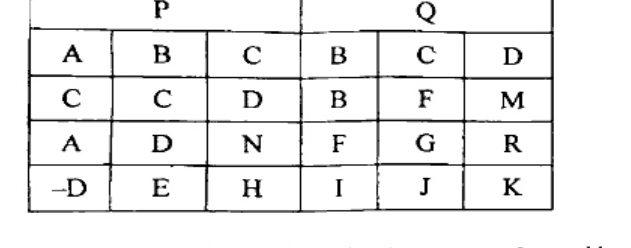
7 MarksbFind the Cartesian product of the following P and Q.
How to answer
- Define Cartesian product $P \times Q$
- Combine every tuple of P with every tuple of Q
- List resulting schema and 9 tuples
-
7 MarksaDefine primary key and foreign key constraint and how these constraints are expressed in SQL?
How to answer
- Define primary key: unique, not null, one per table
- Define foreign key: references primary key of another table
- Show SQL syntax with PRIMARY KEY and FOREIGN KEY REFERENCES example
-
7 MarksbDescribe about tuple relational calculus with suitable example.
How to answer
- Define tuple relational calculus form {t | P(t)}
- Explain tuple variable and predicate
- Give suitable example query with result
-
7 MarksaIllustrate insertion, deletion and modification anomalies with suitable examples.
How to answer
- Define anomaly due to redundancy in unnormalized relation
- Illustrate insertion anomaly with example
- Illustrate deletion and modification anomalies with examples
-
7 MarksbGiven below are the two sets of FD's for a relation $R(A, B, C, D, E)$, are they equivalent? Explain.
- i)$A \to B, AB \to C, D \to AC, D \to E$
- ii)$A \to BC, D \to AE$
How to answer
- Compute closures under set i) to derive A->BC and D->AE
- Compute closures under set ii) to derive A->B, AB->C, D->AC, D->E
- Conclude equivalence if both covers imply each other
-
7 MarksaWhat is Normalization? Explain about 4NF with an example.
How to answer
- Define normalization and need to remove anomalies
- Define 4NF: BCNF plus no non-trivial multivalued dependency
- Give example relation violating 4NF and its decomposition
-
7 MarksbHow does the granularity of data items affect the performance of concurrency control? Explain.
How to answer
- Define granularity: database, table, page, tuple, field level
- Explain trade-off: coarse reduces overhead but less concurrency
- Explain fine increases concurrency but locking overhead
-
7 MarksaWrite the advantages and disadvantages of validation protocol.
How to answer
- Define validation / optimistic concurrency protocol phases
- List advantages: no locking, high concurrency for low conflict
- List disadvantages: restarts, starvation, overhead
-
7 MarksbConsider the two transactions T1 and T2, both the transactions subtracts 100 from A and adds to B and the time stamps of T1 and T2 are 5:15pm and 5:16 pm respectively. Illustrate a schedule if the entire system clock is set to zero.
How to answer
- State T1 and T2 operations: read A, A=A-100, write A, read B, B=B+100, write B
- Use timestamps 5:15pm and 5:16pm with clock zero for ordering
- Draw time-ordered schedule illustrating execution
-
7 MarksaExplain RDBMS architecture with all components.
How to answer
- Define RDBMS layered architecture
- Explain components: client, query processor, storage manager
- Show block diagram of components and interaction
-
7 MarksbWhat are the key characteristics of ANSI SQL? Explain in detail.
How to answer
- Define ANSI SQL standardization purpose
- List characteristics: portability, standard DDL/DML, data integrity
- Explain each characteristic in detail
-
14 MarksWrite a short note on any two of the following:
- a)Schemas and Instances
- b)Triggers
- c)Query Optimization
- d)Serializability
How to answer
- Select any two topics from four options
- Give definition, purpose and key points for each
- Add example/diagram where applicable
Go to where you left off?
Quick Add to Notes
Save questions, your own notes and screenshots into notes filed by unit. It takes a free account.
Create free accountHave an account? Log in
Notes Panel